Bring renewable energy into the classroom.
The Waste2Light Green Energy Corner is a practical STEM and renewable-energy learning space where students learn by building, measuring, testing, troubleshooting and presenting projects.
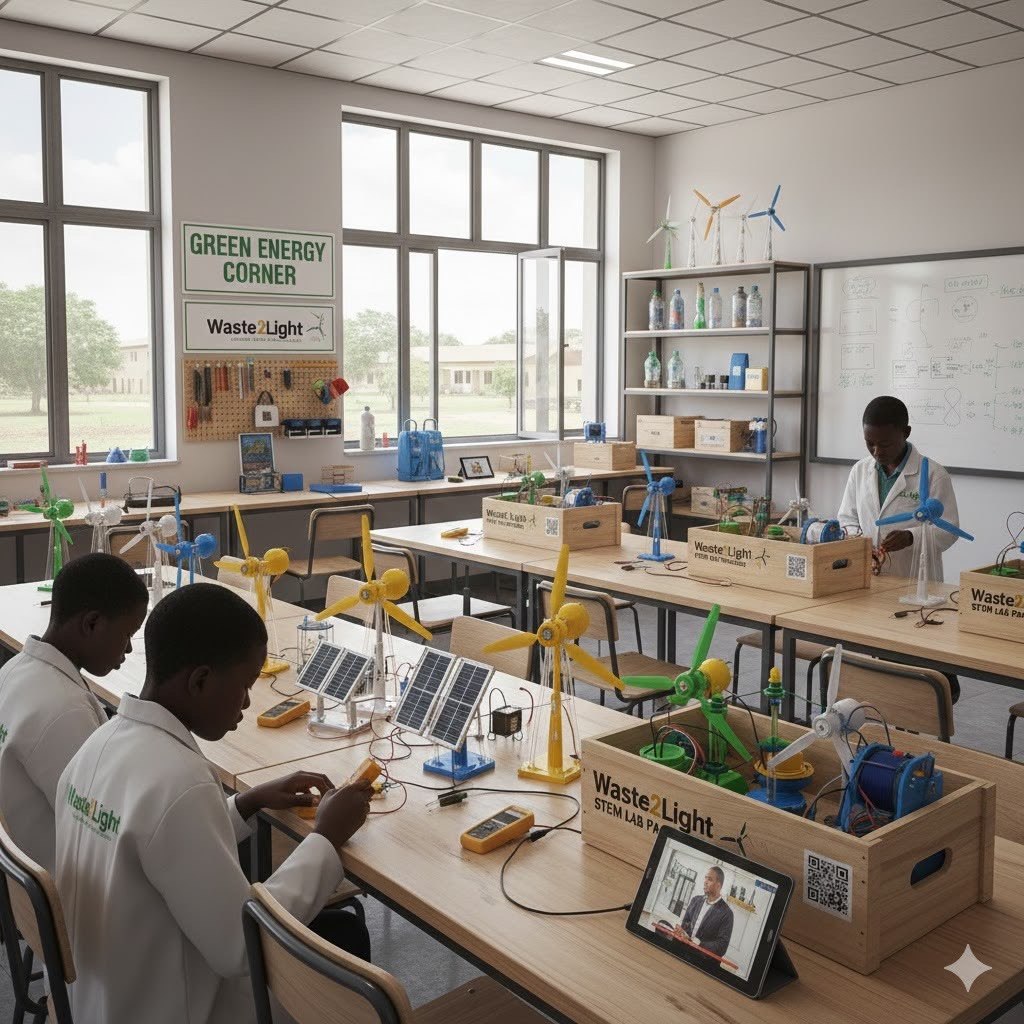
A room where energy stops being theory.
Rather than a demonstration cupboard, the Green Energy Corner is a working space: kits on benches, instruments in hand, projects on display. Students generate electricity, measure it, and find out what happens when a circuit is wrong.
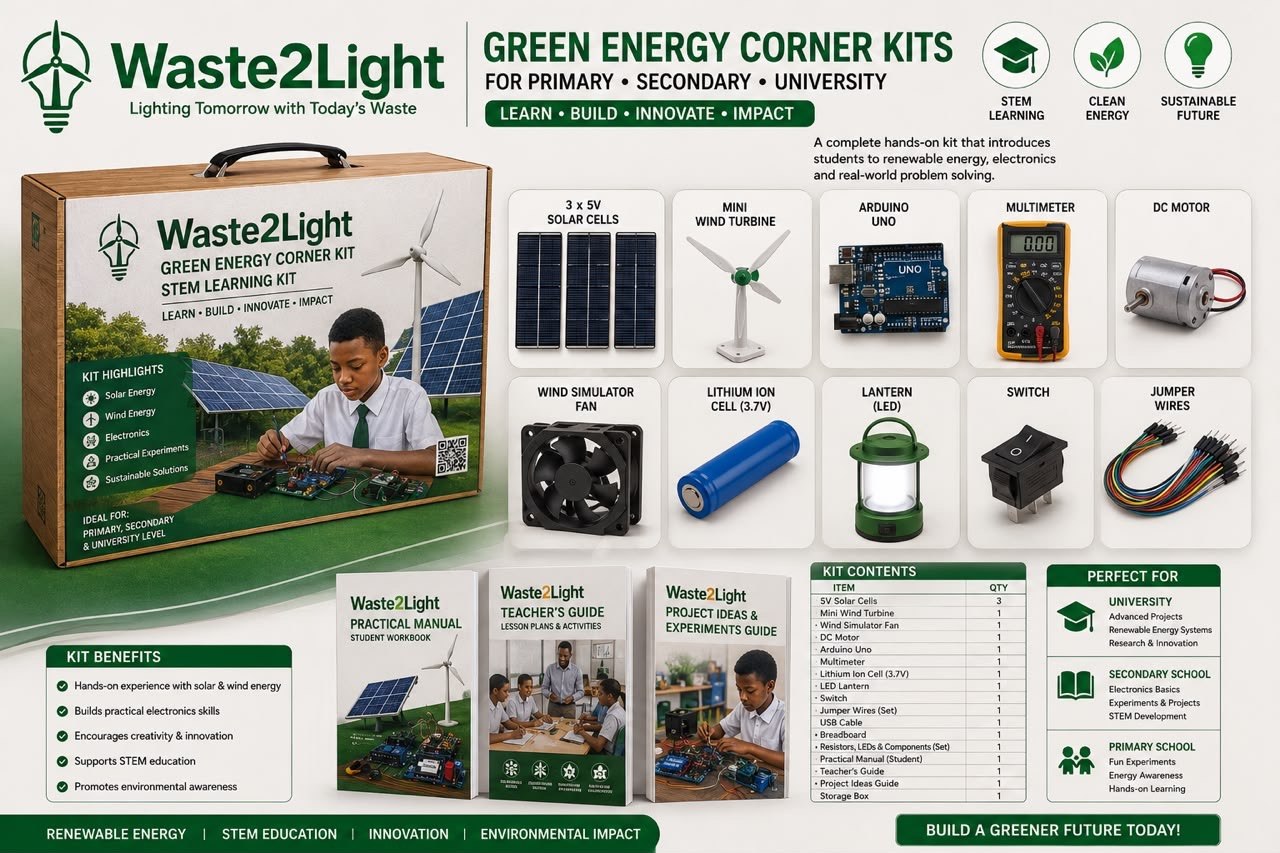
A practical environment for building, testing and learning.
The Green Energy Corner brings renewable-energy tools, practical experiments and project-based learning into the school environment.
Discover. Build. Test. Innovate.
Five stages that repeat every term, each one grounded in physical work rather than theory alone.
- Learning
Understand renewable energy and how things work.
Students start with the ideas behind energy: where it comes from, how it moves, and why systems are built the way they are.
- Building
Work with real components and practical kits.
Solar cells, mini wind turbines, motors, wires and boards. Nothing simulated — students assemble working circuits by hand.
- Testing
Measure, experiment and compare results.
Multimeters in hand, students take readings, compare outputs and see for themselves how much energy a system really produces.
- Troubleshooting
Find the fault and fix it.
Structured fault-finding turns a circuit that does not work into the most useful lesson of the session.
- Innovating
Turn ideas into projects and demonstrations.
Each cycle ends with a project built, explained and demonstrated by the students who made it.
A space designed for making.
The Green Energy Corner is organised into zones so a class can move from explanation to build to demonstration without rearranging the room.
Where a session opens. Concepts, briefs and demonstrations are delivered to the whole class before hands reach the components.
Start with five kits. Build from there.
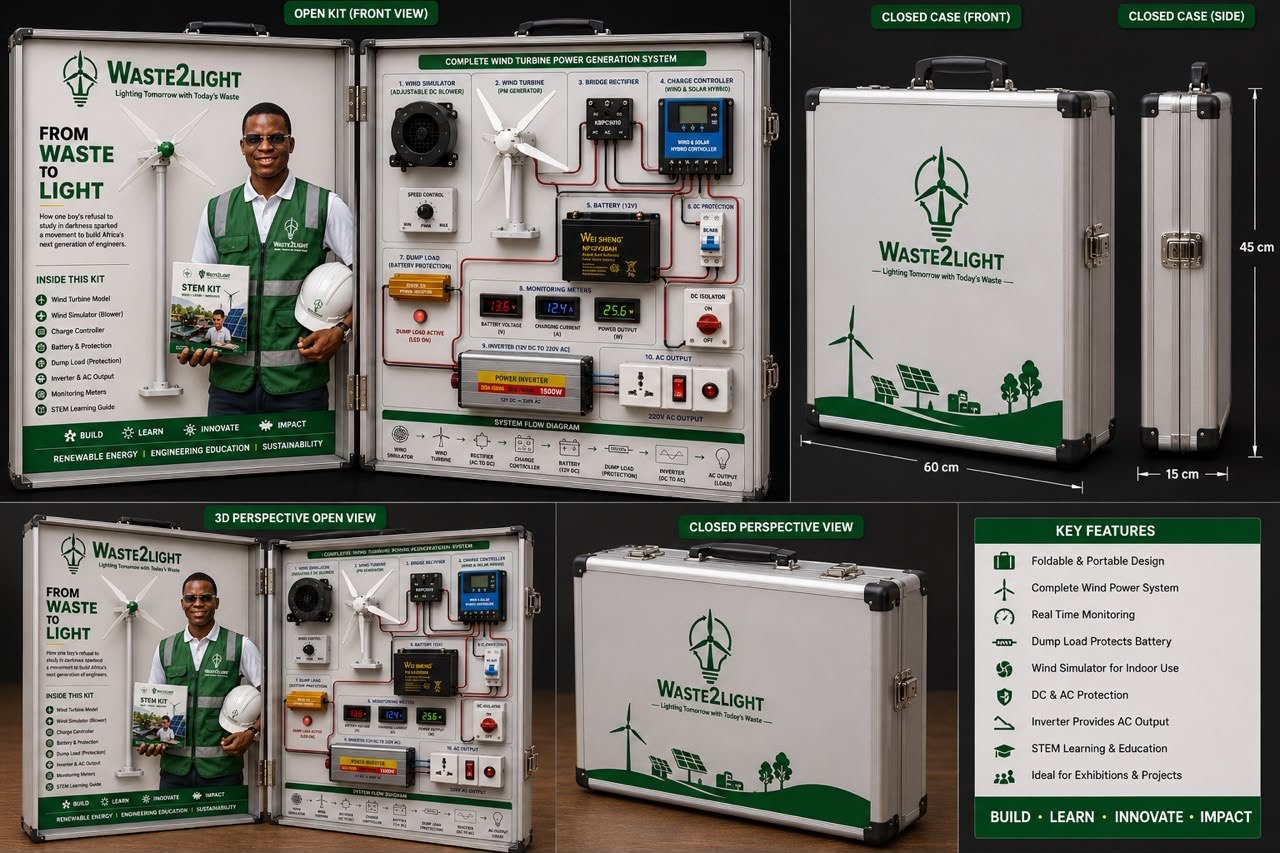
Each Green Energy Kit holds the components a class needs to generate, measure and use electricity for the first time.
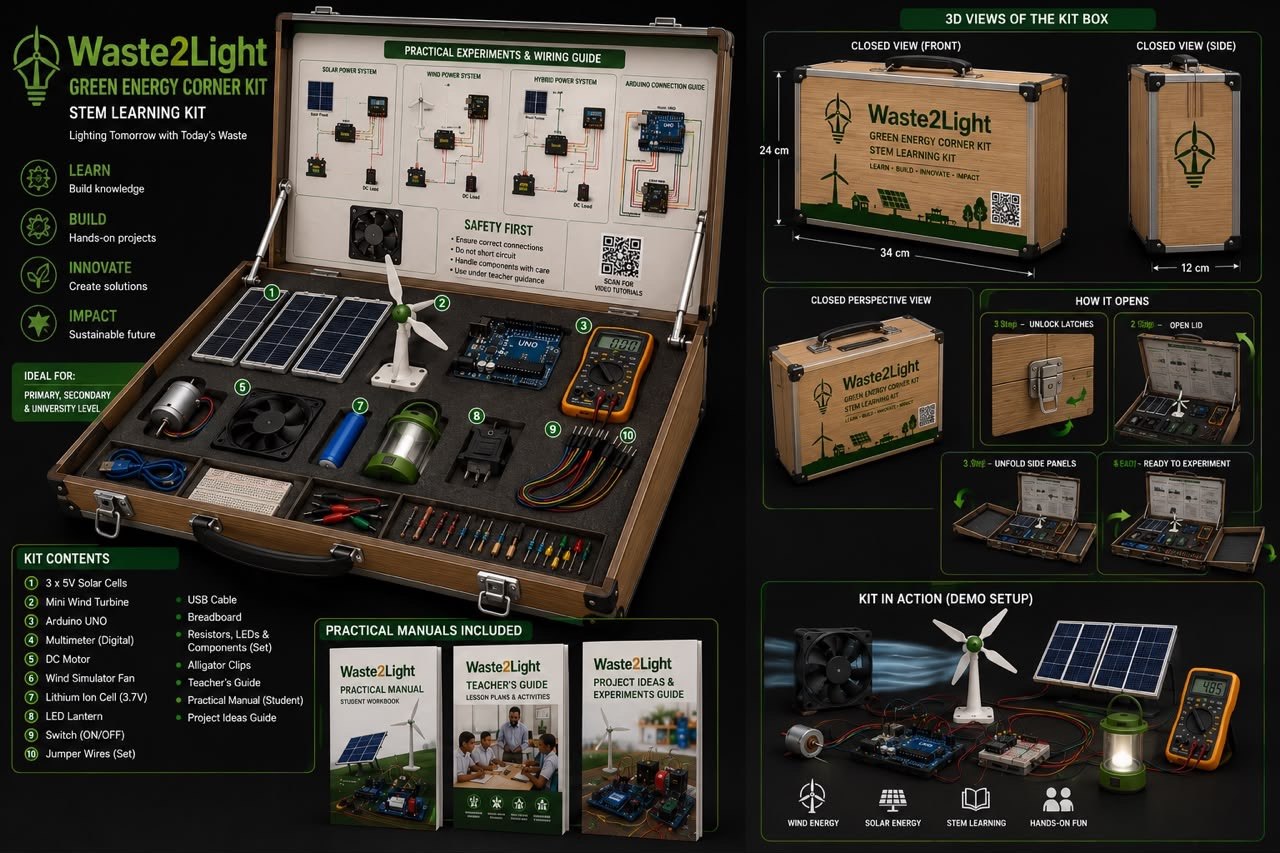
- 015V solar cellsPhotovoltaic energy capture
- 02Mini wind turbineWind-to-electricity conversion
- 03Arduino UnoMicrocontroller for coding and control
- 04Digital multimeterVoltage and current measurement
- 05DC motorElectrical to mechanical energy
- 06Wind-simulator fanRepeatable indoor wind testing
- 073.7V lithium-ion cellEnergy storage and charging
- 08LED rechargeable lanternThe original Waste2Light product, as a working demo
- 09ON/OFF switchCircuit control
- 10BreadboardSolderless circuit prototyping
- 11Jumper wiresCircuit connection and rewiring
- 12USB cablePower and programming
- 13LEDs & resistorsLoad, indication and current limiting
- 14Basic electronics componentsConnectors, fittings and consumables
Component list as documented in the Green Energy Corner programme material. Quantities, ratings and full specifications are published once confirmed by Waste2Light.
Every practical has a learning path.
The physical kit is one half. The other half is the guidance that surrounds it — printed, scanned and watched.
Solar & Wind Tutorials
Step-by-step video walkthroughs of the core renewable-energy practicals.
Electronics & Arduino
Circuit fundamentals and coding sessions built around the kit components.
STEM Experiments
Repeatable classroom experiments with clear expected results.
Troubleshooting
Structured fault-finding so students learn from what does not work.
Student & Teacher Demos
Finished student projects and teacher-led demonstrations on video.
QR-Linked Manuals
QR codes on kits and printed manuals open the matching video instantly.
The work the room produces.
Every cycle ends with student projects built, demonstrated and documented.
PlaceholderStudent project photography, titles and write-ups from participating schools, to be added as the first cohorts complete their practicals.
Start small. Build something bigger.
The first five kits are the beginning, not the destination. Each level adds capability to the same room.
- Track 1
Green Energy
The starting point. Practical solar, wind and energy work with real components.
- Track 2
Electronics
Circuits, measurement, components and fault-finding as a discipline of their own.
- Track 3
Arduino & Coding
Microcontrollers, sensors and code layered onto the energy fundamentals.
- Track 4
Robotics
A separate expansion kit taking students into control and automation.
- Track 5
3D Printing
Students move from assembling parts to designing and producing their own.
- Track 6
Maker / Prototyping
Fabrication, tooling and the workflow of turning an idea into a built object.
- Track 7
Advanced Renewable Energy
A full technology laboratory capable of serious student engineering.
Built with schools. Designed to grow with them.
A clear split of responsibilities keeps setup realistic and the programme sustainable.
Waste2Light provides
- Green Energy STEM Kits
- Laboratory setup guidelines
- Recommended laboratory layout
- Teacher guidance and orientation
- Practical learning resources
- Digital learning content
- Student practical projects
- Technical support
The school provides
- Suitable laboratory space
- Furniture built to Waste2Light standards
- Electrical infrastructure
- Safety provisions
- Secure storage
- Teachers / facilitators
- Internet and display where possible
- Laboratory maintenance
A lab that can keep growing.
Approved practical activities may contribute to a school Innovation Account — a small internal fund that keeps the room stocked and moving after the first term.
- 01Replacement components
- 02STEM materials
- 03Repairs
- 04Student projects
- 05Future innovation activities
Contribution structure and commercial terms are agreed directly with each school and are not published here.
Eleven steps from empty room to first practical.
The implementation checklist used with every school.
- 01Confirm the room to be used as the Green Energy Corner
- 02Record room dimensions and take photographs
- 03Build practical furniture to the recommended standard
- 04Confirm electrical infrastructure and sockets
- 05Prepare a display area for student projects
- 06Arrange internet access where possible
- 07Put safety provisions in place
- 08Take delivery of and inventory the kits
- 09Complete teacher orientation
- 10Run the first practical session
- 11Document the first student projects

Let's build what comes next.
Whether you're a school, organisation, technology partner or potential collaborator, start a conversation with Waste2Light.